
A History of the Cairn Terrier
The Cairn is a very old kind of dog with a comparatively young name. The type worked the Scottish Highlands and Western Isles for centuries; the label "Cairn Terrier" is barely more than a hundred years old.
The word itself
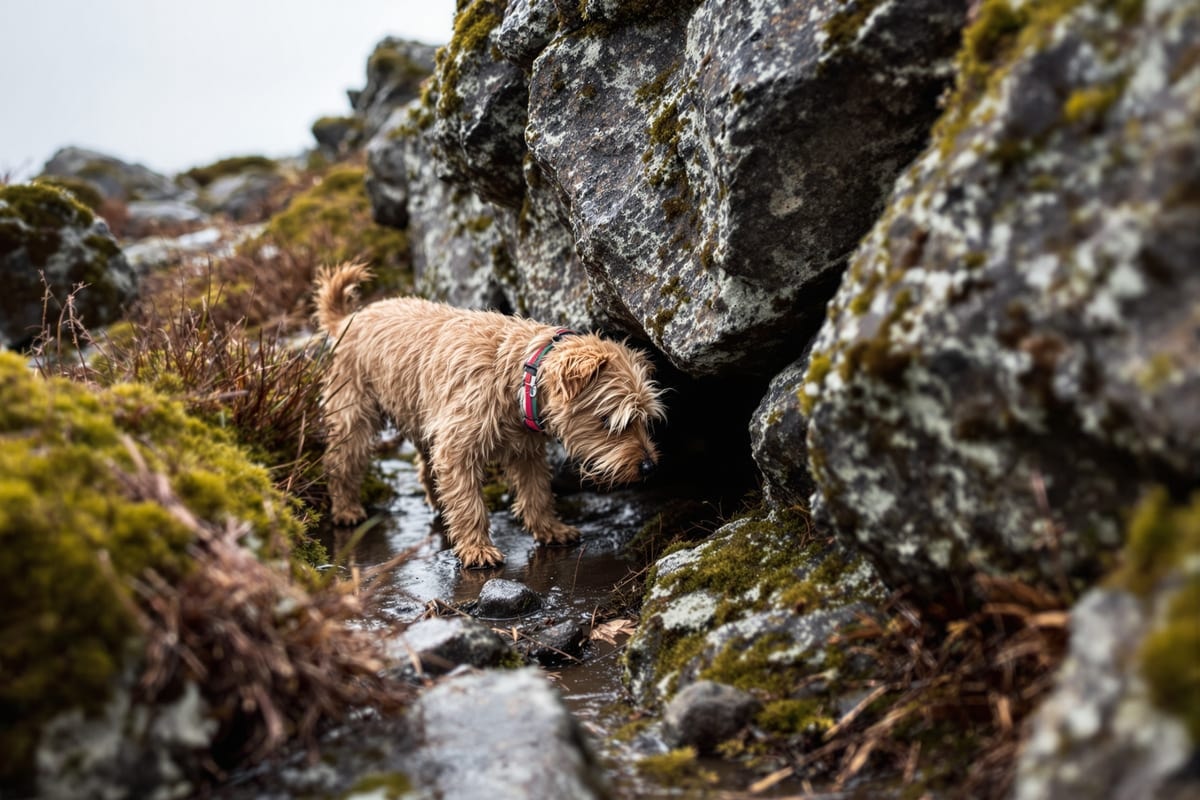
"Terrier" comes from the Latin terra, earth — a dog that goes to ground. A cairn is a heap of stones. Across the Highlands and islands, cairns were raised as boundary markers, waymarks on hill paths, burial markers and memorials, and they have been part of the landscape for a very long time. Left alone for a few generations, a pile of loose stone becomes exactly what a fox, a badger or a colony of rats would choose to live in. A small, hard, weatherproof dog that could push into those gaps and work in the dark was not a luxury on a Highland croft. It was pest control, and it was how the grain and the poultry survived the winter.
Type before breeds
For most of their history these dogs were not a breed in the modern sense. Crofters and estate keepers in Skye, Argyll and the west kept working strains, bred for what worked, and named them locally rather than nationally. Written references to small Scottish earth-working terriers go back centuries, and the traditional accounts — often repeated in breed literature — include King James VI of Scotland sending a group of small "earth dogges" from Argyllshire to France as a gift, supposedly split across two ships so that a single loss at sea would not destroy the group. It is a good story and it is very widely retold; like most breed origin stories from that period it should be read as tradition rather than documentation.
What is clear is that a family of related short-legged Scottish terriers existed, worked, and only later separated. The Cairn, the Scottish Terrier, the West Highland White and the Skye Terrier all sit in that family, and the Norwich and Norfolk terriers are close relations from the other side of the border. Dogs that would now be sorted firmly into different breeds once appeared in the same litters.
Becoming a breed
The separation happened in the late nineteenth and early twentieth centuries as organised dog showing spread and registries began requiring dogs to be one thing or another. The short-legged Scottish terriers were divided up, standards were written, and the name "Cairn Terrier" was settled on for the working type that had not been bred toward a particular colour or a heavier show build. Registration in Britain followed in the years around the First World War, and the breed reached North America in the same period.
The breed's admirers have always argued that the Cairn came out of this process better than most, precisely because it was never redesigned. The Kennel Club's breed standard still describes a functional working dog rather than an exaggerated one, and the American Kennel Club's breed information makes the same point about the breed's continuity. A Cairn from a century ago would not look out of place today, which is not something that can be said of every terrier.
The film that changed everything, briefly
The breed's most famous moment came in 1939, when a brindle Cairn played Toto in the film adaptation of The Wonderful Wizard of Oz. The effect on the breed's visibility was enormous and the effect on the breed itself was mixed. Public recognition brought a surge of interest from people who wanted a specific look rather than a specific dog, and breed rescue volunteers have spent the decades since explaining, patiently, that a Cairn is a working terrier and not a film prop. It remains one of the most common wrong reasons to acquire the breed — see our page on breed rescue for how that plays out.
Working roots you can still see
The history is not decorative. It is legible in the dog in front of you: the harsh weatherproof double coat that shed Highland rain, the strong digging feet, the deep chest that still had to fit through a gap in stone, the independence of a dog that worked out of sight and out of earshot of its handler, and the prey drive that no amount of sofa life has diluted. Earth-working aptitude is still tested formally — the AKC's Earthdog programme exists for exactly this — and Cairn owners who try it are frequently startled by how much of the job their pet already knows.
Further reading
For the official descriptions and for the parent-club literature, see the resources page. For how the breed's history translates into a modern household, the breed profile is the place to start.