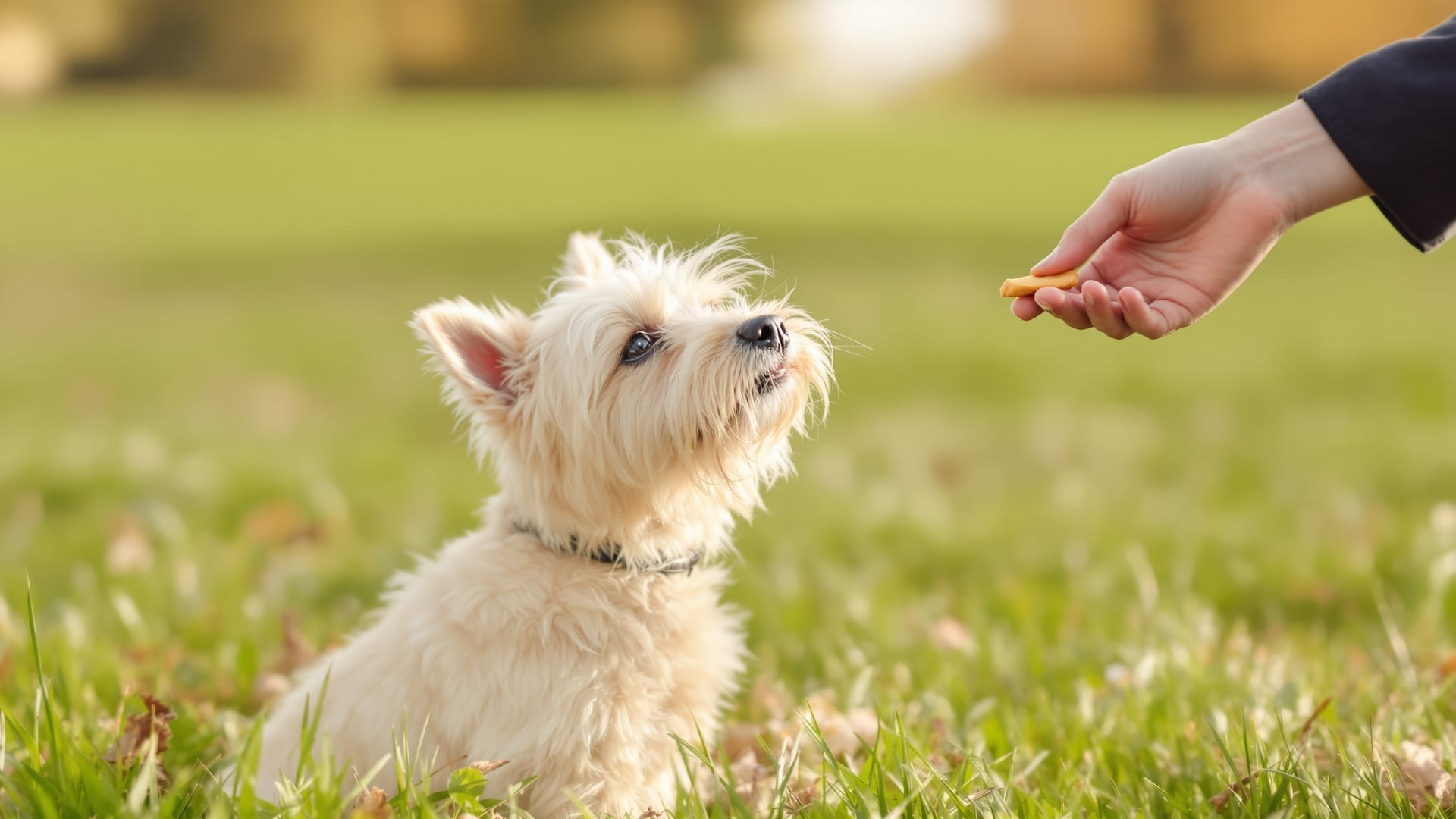
Training a Cairn Terrier
Cairns are clever, quick to learn and completely unimpressed by authority. Train one with rewards and a sense of humour and you will get a delightful dog. Train one with force and you will get an argument you cannot win.
Start from what the dog is for
A Cairn was bred to work alone underground and make its own decisions. Independence is not a training failure to be corrected; it is the breed operating correctly. The productive approach is to make cooperation obviously worth the dog's time, every time, rather than to demand compliance for its own sake. The American Veterinary Society of Animal Behavior sets out the evidence on reward-based methods and on why aversive tools carry real behavioural risk; that is the framework this page follows.

Recall: the one that will not fully arrive
Be realistic. A recall trained to a high standard in the house, in the garden and on a long line will hold up in most ordinary situations. It will not reliably beat a squirrel at twenty feet, and building a training plan that assumes it will is how dogs get lost or hit by cars.
Practical shape of the work:
- Pay properly. Recall is not the place for kibble. Use something the dog would cross a road for, and never let coming back predict the end of the fun.
- Use a long line in open spaces for months longer than you think necessary. It preserves the training rather than gambling it.
- Never call once and give up. Every ignored recall cue teaches the dog that the word is optional.
- Train around progressively harder distractions — but accept a ceiling. Off-lead freedom belongs inside a fence.
Make practice specific
Teach a familiar cue in a new place as though it is a separate exercise. A sit beside the kitchen counter and a sit beside an open gate ask for the same movement under different distractions. Start with the gate closed, stand close and reward the response there before adding distance or opening it. Change one feature at a time so you can tell which part is too difficult.
Keep household practice consistent. Choose the cue, the action it means and the moment when the reward appears, then have each person rehearse that same small task. Avoid giving several words for one request or repeating a word while the dog is occupied elsewhere. Finish with something familiar. A note about the setting and distraction is more useful than labeling the dog stubborn after an unsuccessful attempt.
Containment, done properly
Fencing is training equipment for this breed. Walk the boundary and look at it the way a terrier would: gaps under gates, soft soil at the base of a fence, a wobbly panel, a gate latch that a determined nose can shift. Cairns dig, and they are persistent. A buried barrier or a run of paving along the fence line solves most of it.
Underground electronic fencing is a poor fit here. A dog with strong prey drive will accept the correction to get out after something and will then refuse to accept it to come back in — so the system fails in the one direction that matters, and the dog ends up loose on the far side of it.
The mental work
A bored Cairn is a destructive Cairn, and physical exercise alone does not fix it. Twenty minutes of thinking tires this breed more than an hour of walking.
- Scentwork and find-it games. The breed's nose is its best feature and searching satisfies it deeply.
- Food puzzles and scattered meals instead of a bowl.
- A legitimate digging pit — a sandpit with toys buried in it, praised enthusiastically, so the flowerbeds lose their appeal.
- Trick training. Cairns are performers and enjoy an audience.
- Earthdog and terrier sports. The AKC's Earthdog programme tests the instinct in a controlled setting and is enormously satisfying for the dogs.
Common problems and the honest answer
- Barking. Manage the triggers, teach an alternative — go to a mat, come and tell me — and accept that a terrier will announce things. A silent dog is not on offer.
- Digging. Redirect rather than forbid. See above.
- Resource guarding. Terriers can be possessive about high-value items. Trade, never grab, and get professional help early if it escalates — this is one to take seriously rather than tough out.
- Lead pulling. A well-fitted harness plus consistent reinforcement for a loose lead. No corrective collars.
- Selective deafness. Usually a sign the reinforcement history is too thin for the level of distraction. Go back a step.
Puppies and new adults
Socialisation in the first months — broad, positive, unhurried exposure to people, surfaces, sounds and other dogs — is the highest-return work you will ever do, and the window does not reopen. For a rescued adult, spend the first fortnight doing almost nothing: a settled routine, a quiet space of its own, short walks, no visitors, no testing. Training starts once the dog has decided the household is safe. Our rescue page covers what to expect from an adopted Cairn, and the temperament page explains the mind you are working with.